How to Run a Water Sports Rental Business: The Complete Operator's Guide (2026)
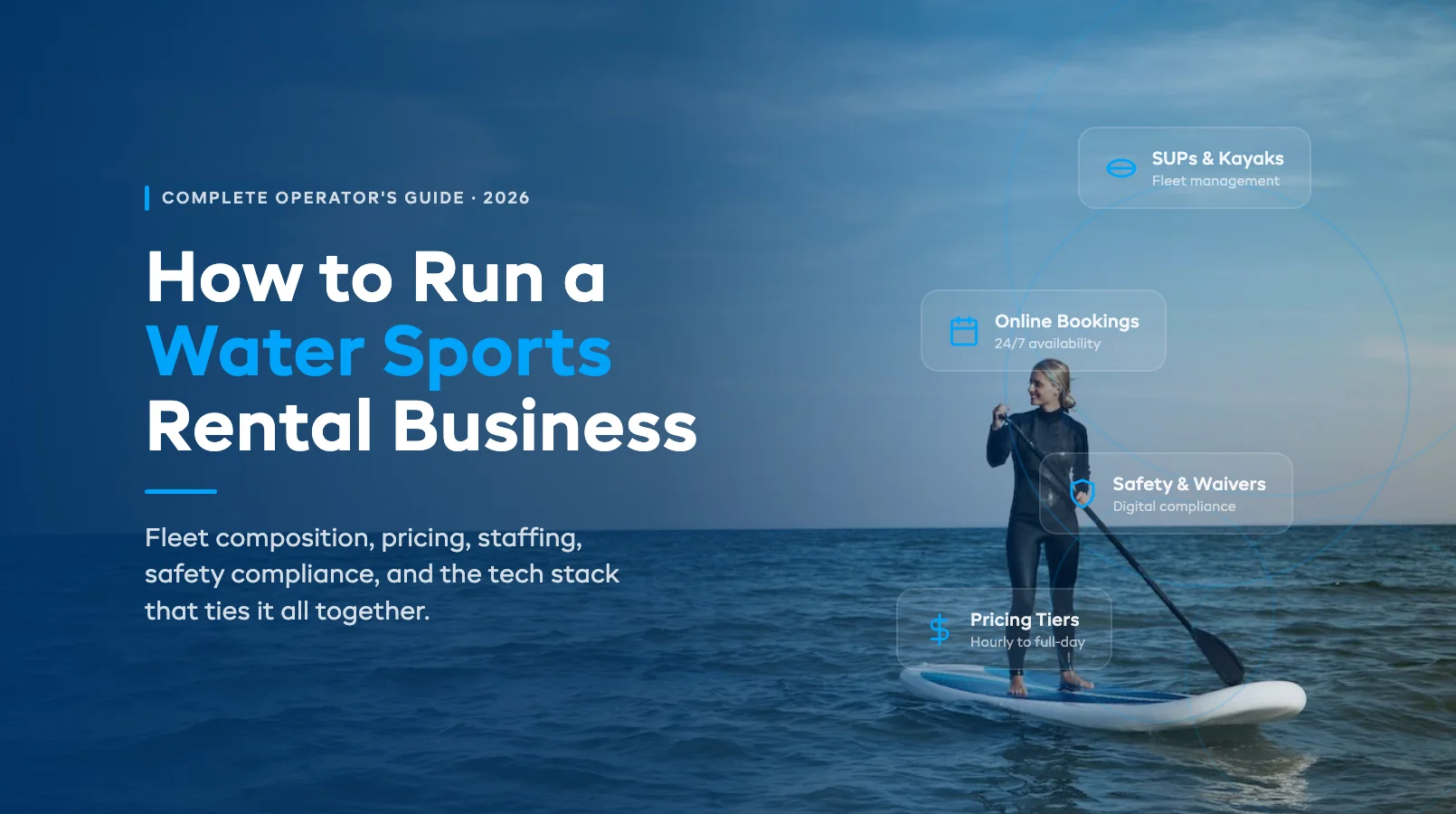
Running a water sports rental business sounds simple until you're standing on the dock at 7am with 40 kayaks, 20 SUPs, a dozen surfboards, a weather warning on your phone, and a line of customers who all booked the same 9am slot. The gap between "I love paddleboarding, I should rent these out" and "I run a profitable operation" is wider than most people think.
This guide covers the full picture — from fleet decisions and pricing to staffing, safety compliance, off-season revenue, and the tech that ties it all together. Whether you're launching your first SUP rental business or scaling an established kayak rental operation across multiple waterfront locations, the playbook is here.
What Counts as a Water Sports Rental Business
A water sports rental business rents non-motorised or small-motorised watercraft and gear to customers by the hour, half-day, or day. The category is broader than most people realise. It includes:
- Stand-up paddleboard (SUP) rentals — the fastest-growing segment. Low barrier to entry, lightweight gear, high turnover per day.
- Kayak rentals — single and tandem sit-on-tops for casual paddlers, plus sea kayaks for guided tours.
- Surfboard rentals — often paired with surf lessons. Boards, wetsuits, rash guards.
- Canoe rentals — popular on rivers, lakes, and calm coastal areas.
- Snorkel and dive gear rentals — masks, fins, wetsuits, sometimes tanks.
- Small watercraft — pedal boats, hydrobikes, small sailboats.
What all of these share: seasonal demand, weather dependence, safety requirements, and gear that takes a beating. That combination is what makes water sports rental operations uniquely challenging — and why operators who get the fundamentals right build strong businesses while others churn through a season or two and quit.
The total addressable market is real. The outdoor recreation economy generates over $1 trillion annually in the US alone, and paddle sports participation has grown 26% since 2019 according to the Outdoor Industry Association. Coastal and lakefront communities are seeing more rental shops open every year — which means more competition, but also more demand.
If you're evaluating the water sports vertical specifically, see our water sports hub for a full breakdown of how rental technology maps to this space.
Starting vs Scaling: Two Very Different Problems
Starting from zero
Your first season is about proving the concept, not maximising profit. Keep it lean:
- Start with one activity. SUPs are the easiest entry point — low unit cost ($400–$800 per board), minimal training required for customers, and fast turnover (you can rent the same board 3–4 times on a busy day).
- Begin with 10–15 units. Enough to generate revenue on weekends without a massive upfront investment.
- Secure your waterfront access first. The number-one blocker for new water sports rental businesses isn't gear — it's location. Marina leases, beach permits, and dock agreements vary wildly by municipality.
- Budget $15,000–$40,000 for gear, permits, insurance, and first-month operating costs. That's for a SUP-only operation. Add kayaks and the number moves to $30,000–$60,000.
Scaling an existing operation
If you've done a season or two and you're ready to grow, the problems shift:
- Adding a second activity type (e.g., kayaks to your SUP operation) doubles your fleet management complexity. Different maintenance schedules, storage requirements, and safety briefings.
- Opening a second location means you need systems that work without you physically present. This is where most operators hit a wall — the spreadsheet and phone-call workflow that worked at one dock breaks at two.
- Hiring beyond family and friends. Once you need 5+ seasonal staff, you need training protocols, scheduling systems, and accountability tools.
The lesson: starting is a gear problem. Scaling is a systems problem.
Fleet Composition: What to Stock and How Many
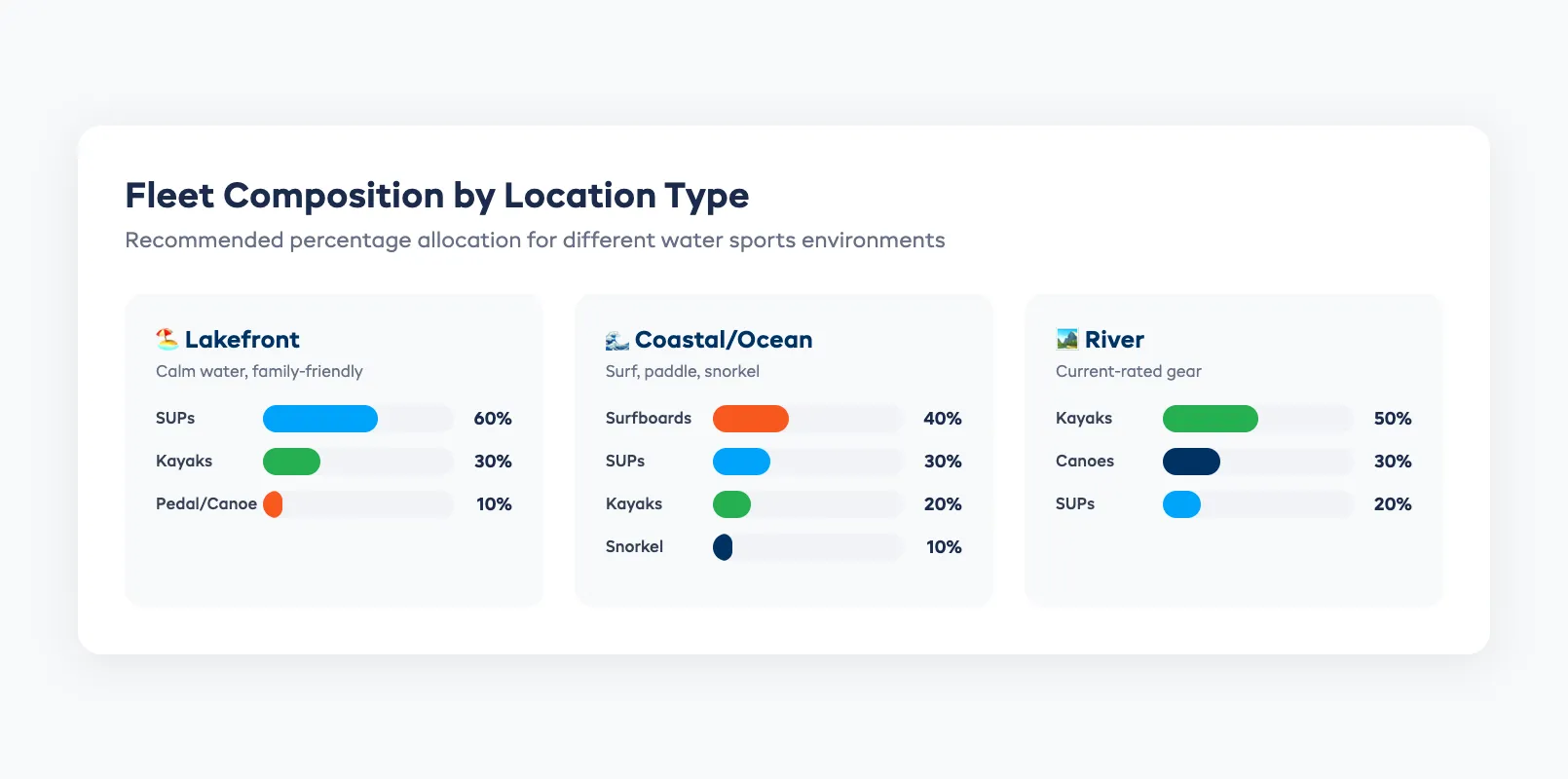
Your fleet mix depends on your location, customer mix, and how much storage you have. Here's a framework:
For a lakefront operation (calm water):
- 60% SUPs (highest turnover, lowest maintenance)
- 30% kayaks (single and tandem mix — tandems are popular with couples and families)
- 10% pedal boats or canoes (the "something different" option)
For a coastal/ocean operation:
- 40% surfboards (mix of soft-tops for beginners and hardboards for experienced riders)
- 30% SUPs (inflatable for easy transport, hardboard for performance)
- 20% kayaks (sit-on-top ocean kayaks)
- 10% snorkel gear sets
For a river operation:
- 50% kayaks (sit-on-top, self-bailing)
- 30% canoes
- 20% SUPs (river-specific wider boards)
How many units do you need? A common formula: take your expected peak-day customers and multiply by 1.3 (to account for overlap between rental periods and turnaround time). If you expect 30 customers on a Saturday, stock 39 units across your fleet.
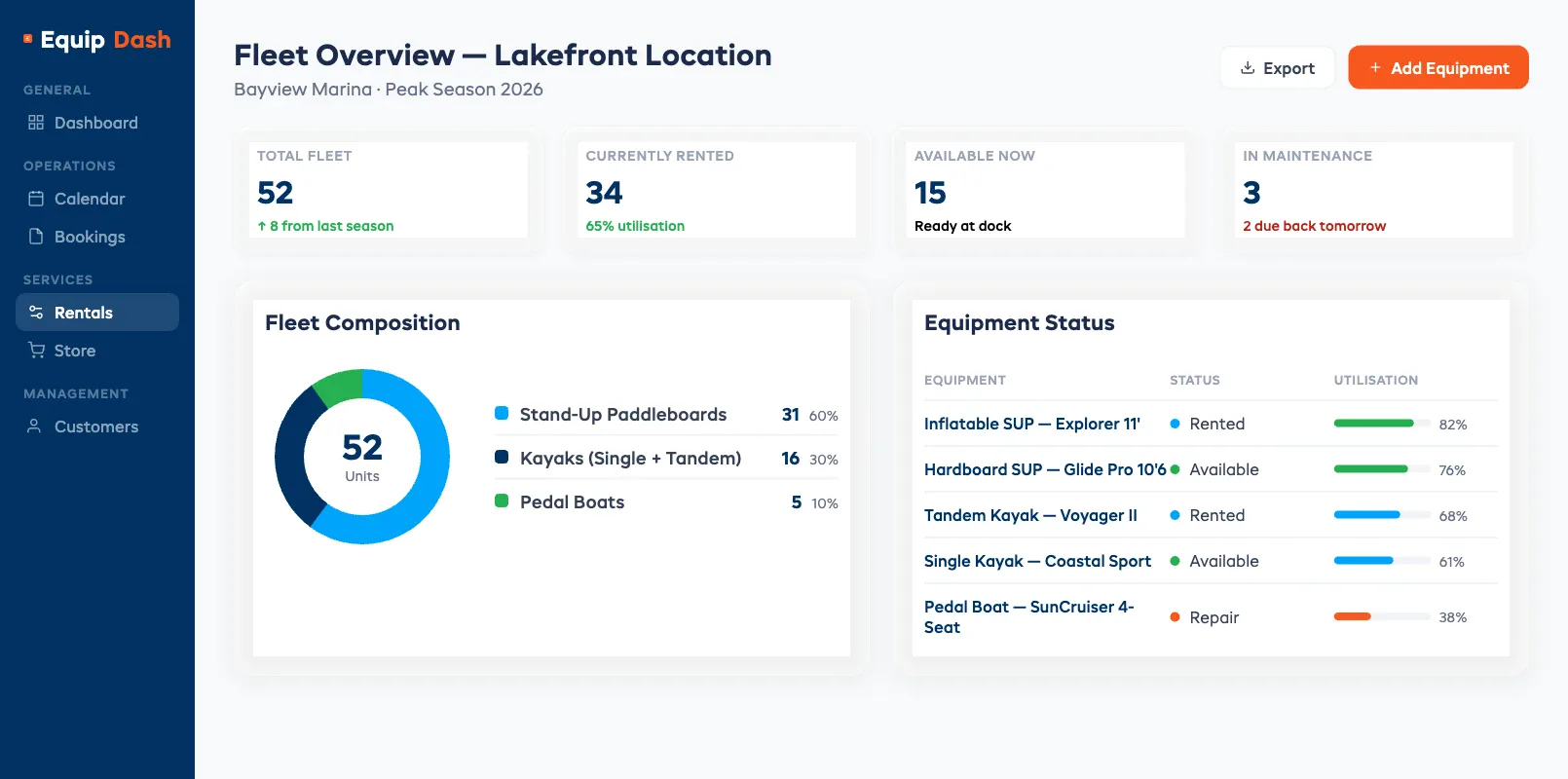
Track utilisation religiously. If a category is sitting below 40% utilisation during peak season, you're over-stocked. Above 85%, you're leaving money on the table. Use your pre-rental inspection checklists to keep every unit in rotation and catch damage before it sidelines gear.
For SUP-specific maintenance, a structured SUP inspection and inflation protocol prevents the two most common SUP failures: slow leaks on inflatables and fin box damage on hardboards.
Pricing by Activity: Hourly, Half-Day, Full-Day
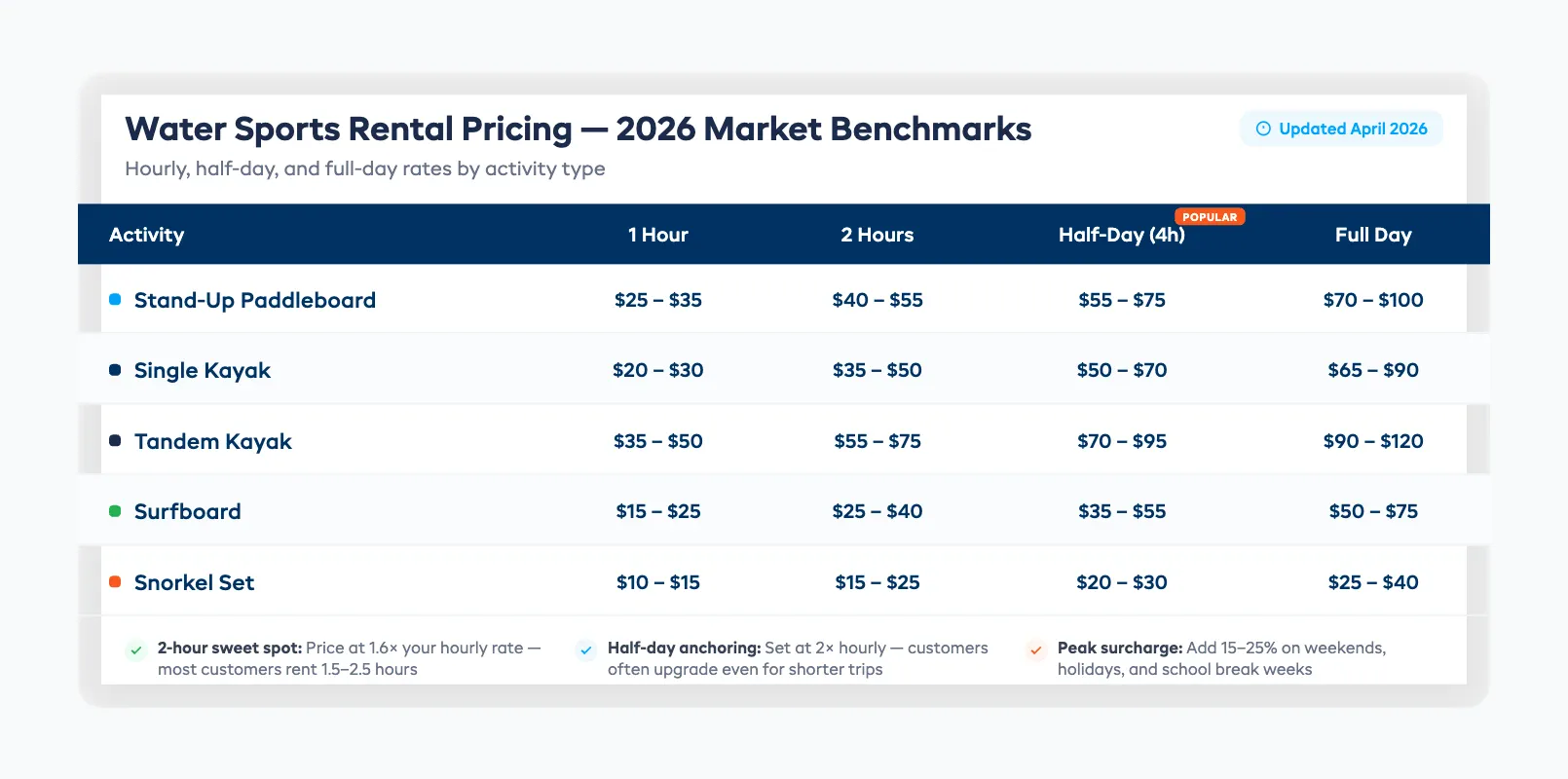
Water sports pricing follows a predictable pattern. Here are 2026 market benchmarks:
| Activity | 1 Hour | 2 Hours | Half-Day (4h) | Full Day |
|---|---|---|---|---|
| SUP | $25–$35 | $40–$55 | $55–$75 | $70–$100 |
| Single kayak | $20–$30 | $35–$50 | $50–$70 | $65–$90 |
| Tandem kayak | $35–$50 | $55–$75 | $70–$95 | $90–$120 |
| Surfboard | $15–$25 | $25–$40 | $35–$55 | $50–$75 |
| Snorkel set | $10–$15 | $15–$25 | $20–$30 | $25–$40 |
Pricing rules that work:
- Two-hour sweet spot. Most customers rent for 1.5–2.5 hours. Price your 2-hour rate at 1.6× your hourly rate — it feels like a deal to the customer and increases average transaction value.
- Half-day anchoring. Set your half-day at 2× hourly. Customers who see "1 hour: $30, half-day: $60" often choose the half-day even if they'll only use 2.5 hours.
- Peak surcharges of 15–25%. Weekends, holidays, and school break weeks. Post the surcharge clearly — operators who hide it get bad reviews.
- Multi-day discounts of 20–30%. Vacation renters want 3–5 day packages. Offer them — the gear would sit idle otherwise.
- Group rates. 10% off for 4+ units, 15% for 8+. Birthday parties, corporate outings, and school groups drive volume.
Your surf rental operator margins will be thinner per unit than SUP or kayak — surfboards take more abuse and have shorter lifespans. Compensate by pairing board rentals with wetsuit upsells ($10–$15/session) and lesson add-ons ($40–$60/hour with instructor).
Staffing: Seasonal Hires and Safety-Qualified Staff
Water sports rental businesses run on seasonal labour. Here's how to structure it:
Core team (year-round, even if part-time):
- You (owner/operator)
- 1 operations manager (if you have 30+ units or 2+ locations)
Seasonal team (peak season, 3–6 months):
- Dock staff: 1 per 15–20 active units. They handle check-in, safety briefings, gear handoffs, and check-out.
- Safety/rescue: 1 certified water safety staff member on duty at all times during operations. Non-negotiable.
- Maintenance: 1 part-time technician per 40 units for daily inspections, repairs, and cleaning.
Certifications that matter:
- Lifeguard or water safety certification — required by many municipalities for any business operating on public waterways.
- First aid and CPR — minimum for all dock staff. Budget $50–$100 per person for certification.
- Instructor certifications (if offering lessons) — ACA for paddling, ISA or local equivalent for surf. Certified instructors command $18–$25/hour; uncertified help gets $14–$17/hour.
The staffing math: For a 30-unit lakefront operation running 10am–6pm, plan for 3 dock staff + 1 safety person + you. That's roughly $2,500–$3,500/week in labour costs during peak season. Your labour-to-revenue ratio should stay below 35%.
Use your opening-day operations checklist to standardise the morning routine for seasonal staff. When you have new hires every May, a documented procedure beats a verbal walkthrough every time.
Safety and Compliance: PFDs, Waivers, and Weather
This section isn't optional. It's the difference between running a business and running a liability.
PFD requirements
Every US state requires PFDs (personal flotation devices) on watercraft. Most require:
- One USCG-approved Type III PFD per person on kayaks and canoes
- PFDs available (not necessarily worn) for SUP users in most states — but worn if outside a swimming/surfing area
- Children under 13 must wear PFDs at all times in nearly every jurisdiction
Stock 20% more PFDs than your max concurrent rental capacity. Sizes range from infant to XXL. A customer who doesn't fit your PFDs is a customer who can't rent — and a potential lawsuit if you let them go without one.
Inspect every PFD before every season and after any incident. Check buckles, straps, foam integrity, and mould. Retire PFDs after 3 seasons of heavy use regardless of condition — the foam compresses and loses buoyancy.
Digital waivers
Paper waivers are a storage nightmare and a legal weak point. Digital waivers:
- Can be signed before arrival (reducing counter time by 3–5 minutes per customer)
- Are timestamped and stored automatically
- Can include photo/video consent, medical disclosures, and minor guardian signatures
- Are searchable — if you need to pull a waiver for an incident report, you find it in seconds, not hours
Your waiver should cover: assumption of risk, equipment responsibility, cancellation/refund policy, medical fitness acknowledgment, and photo/video release. Have a local attorney review it annually.
Weather operations
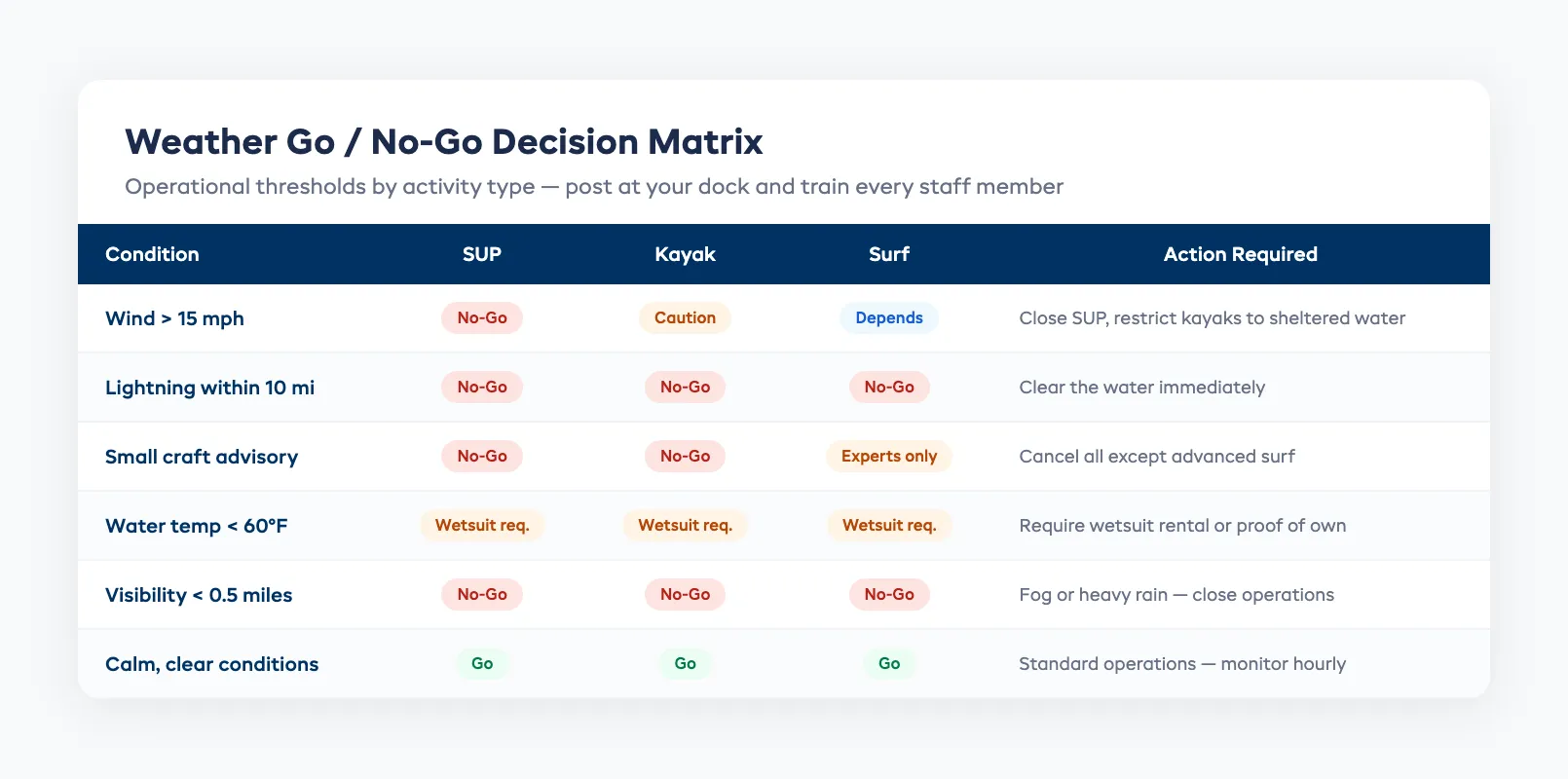
Weather is the number-one operational variable in water sports. You need a go/no-go framework:
| Condition | SUP | Kayak | Surf | Action |
|---|---|---|---|---|
| Wind > 15 mph | No-go | Caution | Depends on swell | Close SUP rentals, restrict kayaks to sheltered water |
| Lightning within 10 miles | No-go | No-go | No-go | Clear the water immediately |
| Small craft advisory | No-go | No-go | Experienced only | Cancel all except advanced surf rentals |
| Water temp < 60°F | Wetsuit required | Wetsuit required | Wetsuit required | Require wetsuit rental or proof of own |
| Visibility < 0.5 miles | No-go | No-go | No-go | Fog, heavy rain — close operations |
Don't wing it. Write your weather policy down, post it at the dock, and train every staff member on it. Automating weather monitoring with a weather alert agent saves you from manually checking forecasts every hour and ensures you never miss a sudden change.
Refund policy for weather cancellations: offer a full reschedule or credit. Refunds eat margin — credits keep the customer in your ecosystem.
Off-Season Revenue: How to Stay Profitable Year-Round
Most water sports rental businesses operate 4–7 months per year. That leaves 5–8 months of zero (or near-zero) watercraft revenue. Operators who survive long-term find ways to fill the gap:
Revenue strategies that work:
- Storage and maintenance services. Offer winterisation and storage for private watercraft owners. Charge $150–$400/season per boat. You already have the space and expertise.
- Gear sales. Sell used rental gear at end of season (50–70% of retail) and stock accessories year-round: dry bags, phone cases, sun protection, paddling gloves.
- Off-season experiences. Cold-water paddling (with proper wetsuit gear), winter fishing kayak tours, holiday events on the water. Niche, but loyal customers pay premium prices.
- Corporate and school programs. Team-building days, school PE partnerships, summer camp contracts. These book months in advance and fill midweek slots.
- Online booking deposits for next season. Early-bird pricing (10% off) for next summer's group bookings. Cash flow in January, guaranteed bookings in June.
The off-season to-do list:
- Full fleet inspection and repair
- Repaint, re-wax, replace worn components
- Update pricing based on last season's data
- Renegotiate marina/dock leases
- Refresh your website and booking system for next season
- Plan marketing campaigns to launch 6–8 weeks before opening day
A well-run water sports rental business targets 65–75% of annual revenue in the peak 4 months, with off-season activities covering fixed costs (rent, insurance, loan payments) during the remaining months. If your off-season months are pure cost with zero revenue, you'll burn through peak-season profits faster than you think.
Tech Stack: The Systems That Run Your Shop
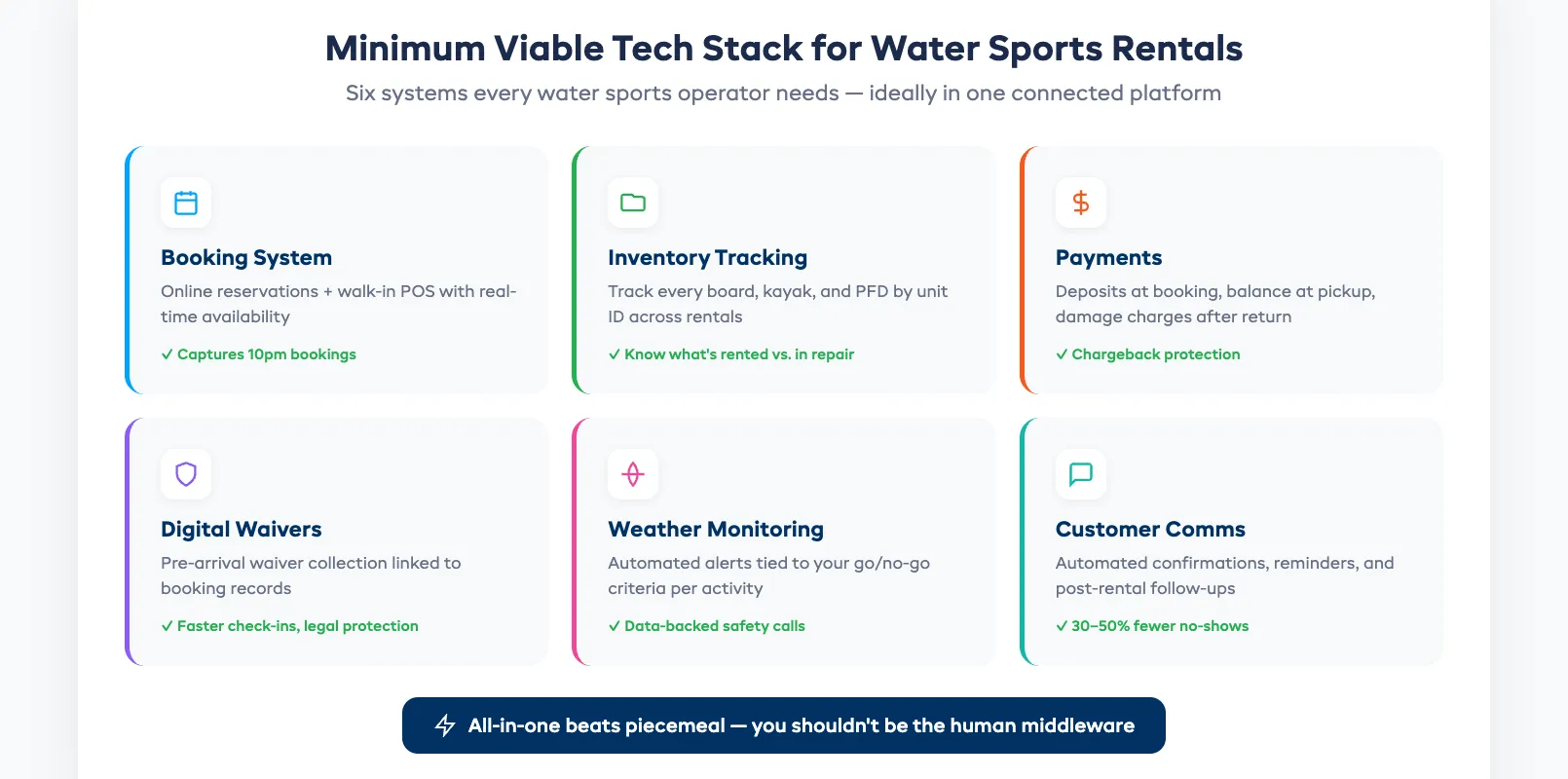
The minimum viable tech stack for a water sports rental business:
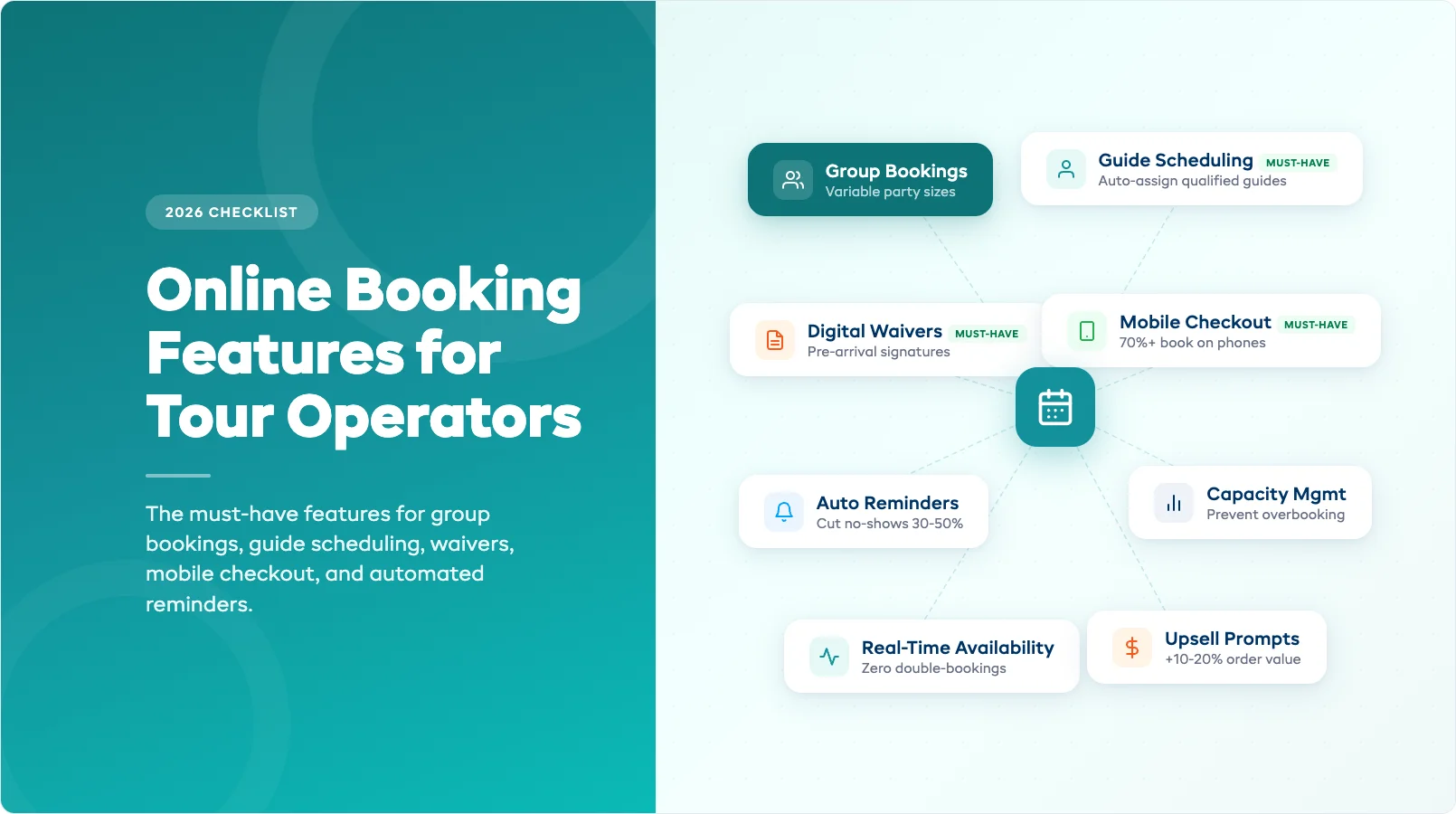
- Booking and reservation system — online, real-time availability, mobile-friendly. Customers book at 10pm from their holiday rental. If you're not online, they book with the shop down the beach that is.
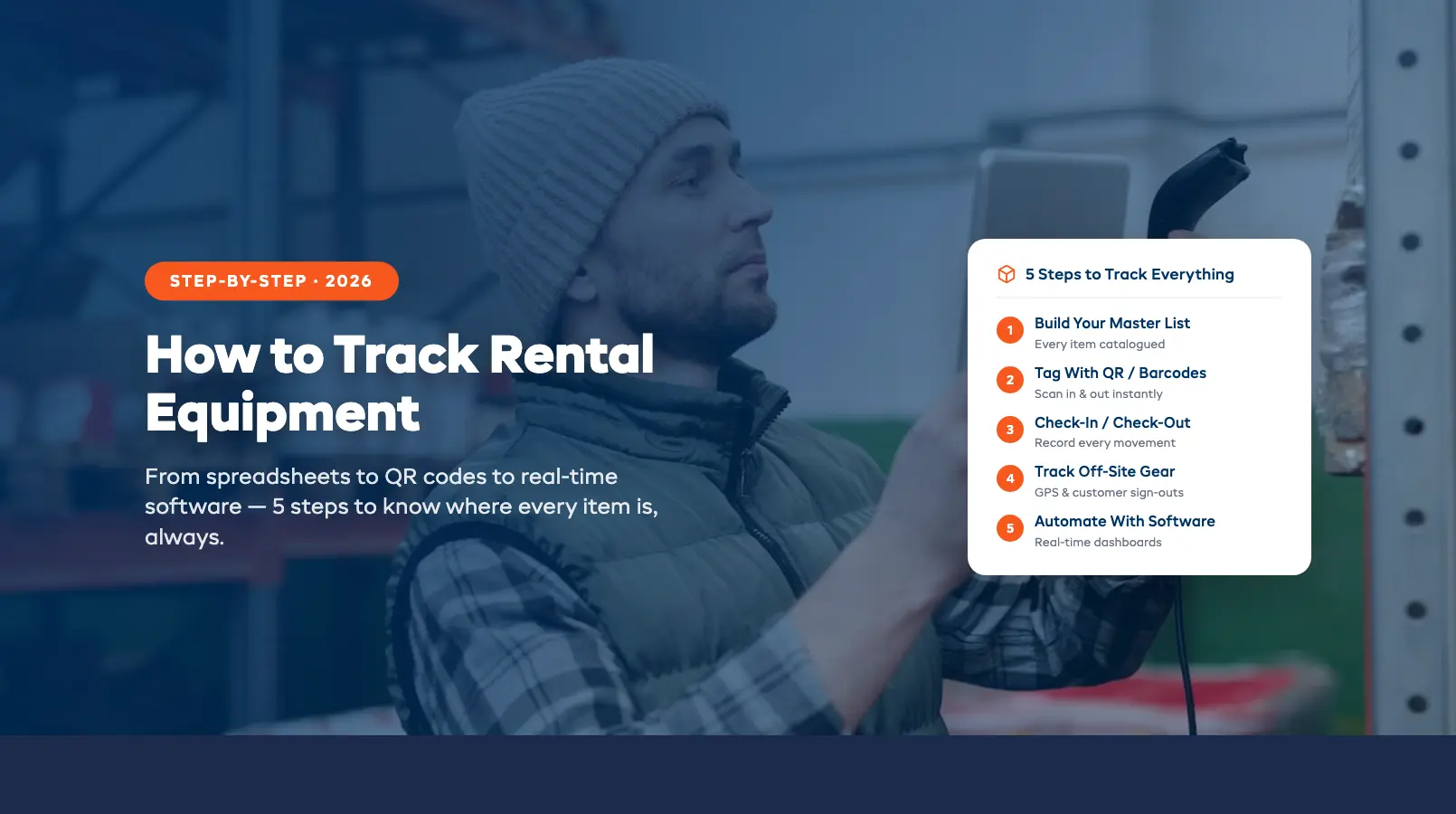
- Inventory management — track every board, kayak, and PFD by unit. Know what's rented, what's available, and what's in for repair at any moment.
- Digital waivers — integrated with your booking flow, not a separate tool.
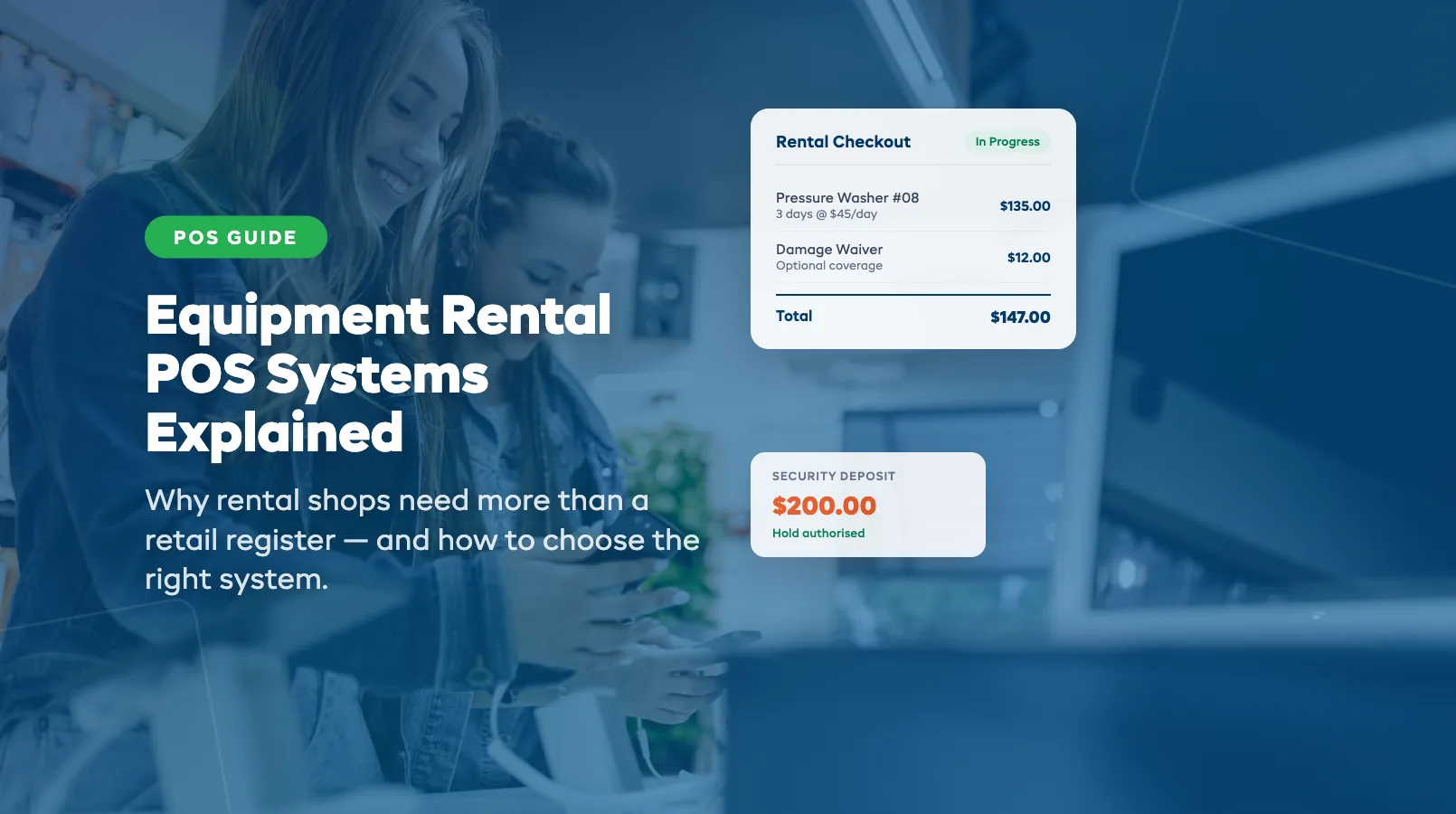
- Payment processing — deposits at booking, balance at pickup, damage charges after return. One system.
- Weather monitoring — automated alerts tied to your go/no-go criteria.
- Customer communications — automated confirmations, reminders (bring sunscreen, arrive 15 minutes early), and post-rental follow-ups.
The common mistake: cobbling together 5–6 separate tools that don't share data. Your booking tool doesn't talk to your waiver tool. Your waiver tool doesn't know your inventory. Your payment tool has no idea a customer cancelled. You become the human middleware — and that doesn't scale past 20 units.
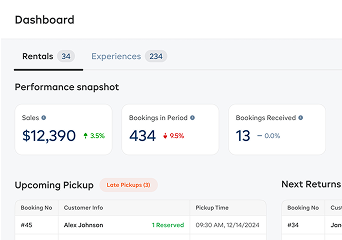
EquipDash combines booking, inventory, waivers, payments, and customer communications in one platform. The built-in Dash AI assistant handles routine tasks — answering booking questions, flagging weather risks, and generating end-of-day reports — so you spend less time at a screen and more time on the water. For more on how rental technology maps to water sports specifically, check our water sports hub and the water sports rental glossary for terminology your team should know.
FAQ
How much does it cost to start a water sports rental business?
Budget $15,000–$40,000 for a single-activity SUP operation (gear, permits, insurance, first-month costs). A multi-activity operation with kayaks and surfboards runs $30,000–$75,000. Location costs vary dramatically — a beach permit might be $500/season in one town and $5,000 in the next.
Do I need special permits or licenses?
Yes. Most municipalities require a business license, waterfront use permit, and liability insurance at minimum. Some states require specific watercraft rental operator licenses. Check with your local parks department, harbour master, and state business licensing office before spending money on gear.
What insurance do I need for a water sports rental business?
At minimum: general liability ($1M–$2M), commercial property (for your gear and shop), and workers' compensation (if you have employees). Many operators also carry inland marine insurance specifically covering watercraft. Budget $3,000–$8,000/year depending on fleet size and location.
How many rentals per day do I need to break even?
For a 20-unit SUP operation with $2,000/month in fixed costs and $30 average rental price: roughly 3–4 rentals per day, every day of the operating season. In reality, weekday volume is 30–50% of weekend volume, so you need 6–8 rentals on Saturdays and Sundays to compensate.
What's the biggest mistake new water sports rental operators make?
Buying too much gear before proving demand. Start with 10–15 units of one type, run a season, and let the data tell you what to add. The second-biggest mistake: skipping digital waivers and weather protocols. One incident without a signed waiver can cost more than your entire fleet.
How do I handle weather cancellations without losing customers?
Offer a full reschedule within the same season or a credit toward a future visit. Avoid cash refunds — they kill cash flow and don't bring the customer back. Post your weather policy clearly on your website, in booking confirmations, and at the dock. Customers who know the rules upfront rarely complain.
Can I run a water sports rental business as a side hustle?
For the first season, maybe — if you hire reliable dock staff and have a booking system that handles reservations without you. But water sports safety regulations mean someone qualified must be on-site during operating hours. Most operators who start part-time go full-time by season two if the business works.
in one place